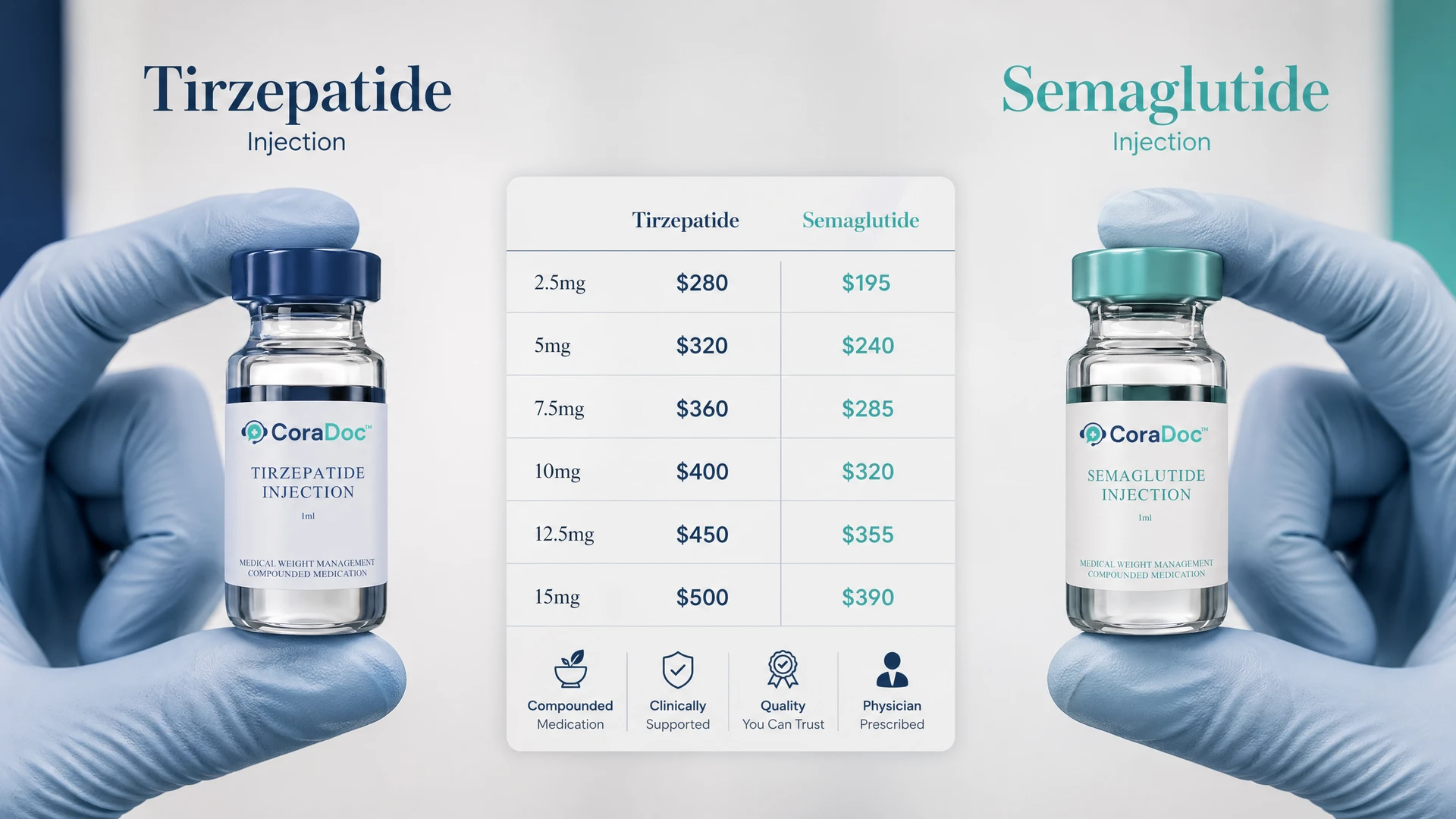
LegitScript Certified · All 50 States · One-Time Payment Affordable Semaglutide Online: $99/Month, No Subscription, No Hidden Fees CoraDoc™ delivers provider-supervised compounded semaglutide starting at $99/month — with free provider visit, free 2-day shipping, and free supplies. One payment. No recurring charges. All 50 states. Start Your Free Consultation → The question most patients ask first is simple: Can I actually get provider-supervised semaglutide for $99 a month? The answer, through CoraDoc™, is yes — and this article explains exactly how that pricing works, what’s included, and why transparency and LegitScript certification make CoraDoc a fundamentally different kind of telehealth provider. How CoraDoc™ Achieves $99/Month Semaglutide Pricing CoraDoc™ operates on a one-time payment model with no subscription, no membership fee, and no hidden charges. The $99/month figure is the effective monthly rate for the 6-month semaglutide program, which costs $595 total. You pay once. Your medication ships. There is no auto-renew. Several structural decisions make this pricing possible: Telehealth model eliminates physical overhead — no brick-and-mortar clinics, no waiting rooms, no administrative layers associated with in-person visits Direct pharmacy partnership with DIRX — medication ships directly from the licensed compounding pharmacy to your door, eliminating retail pharmacy markups All-inclusive pricing — the consultation, medication, shipping, and supplies are bundled into a single price rather than itemized separately with add-on fees Efficient physician workflow — asynchronous intake review allows board-certified physicians to evaluate patients efficiently without sacrificing the quality of individual medical review The result: a LegitScript-certified provider-supervised semaglutide program at a price point that cash-pay patients can actually afford. Complete Pricing: Every CoraDoc™ Semaglutide Plan Program Duration Total Price Effective Monthly Rate Semaglutide 6-Week Starter 6 weeks $299 ~$199/mo Semaglutide 3-Month Standard 12 weeks $495 ~$165/mo Semaglutide 6-Month Full Program 24 weeks $595 $99/mo Every plan includes the Triple Free Promise: free provider visit (no consultation fee), free 2-day shipping via DIRX pharmacy, and free supplies (syringes, alcohol swabs, sharps container). These are not add-ons — they are standard inclusions across all programs. CoraDoc™ vs. Competitors — Transparent Price Comparison Most major GLP-1 telehealth platforms charge significantly more than $99/month, and most require a subscription model that auto-renews monthly. Here is a direct comparison based on publicly available pricing as of 2026: Platform Semaglutide Monthly Rate Payment Model LegitScript Certified CoraDoc™ From $99/mo One-time payment Yes ✓ Hims & Hers ~$199/mo Monthly subscription — Ro Health ~$199–349/mo Membership + medication — Noom Med ~$149–199/mo App subscription required — TrimRx From $199/mo Subscription — At $99/month with no subscription, CoraDoc™ is significantly more affordable than every major subscription-based competitor — and it is the only LegitScript-certified platform in this comparison. LegitScript certification means CoraDoc has passed independent verification of prescribing practices, pharmacy standards, and legal compliance. What’s Included in Every CoraDoc™ Program Free Provider Visit $0 consultation fee Free 2-Day Shipping via DIRX pharmacy Free Supplies Syringes, swabs & more No Subscription One payment. Done. No Subscription — What That Actually Means When CoraDoc™ says “no subscription,” it means your credit card is charged once — for the program you select — and that is the only charge. There is no recurring monthly billing, no auto-renew that you need to remember to cancel, and no membership fee layered on top of the medication cost. This matters because most GLP-1 telehealth platforms operate on subscription models. If you forget to cancel, you continue to be charged. If you want to pause, you may face cancellation fees or lose your place in the program. CoraDoc’s one-time model eliminates all of this complexity. You pay once. You receive your medication. Your provider remains available throughout your program. If you want to continue with a maintenance or follow-on program, that is a separate decision and separate purchase — never an automatic charge. How the Program Works — From Intake to Delivery 1 Complete the online health intake Medical history, current medications, and health goals. No lab work or insurance required. Takes under 10 minutes. 2 Licensed physician reviews your intake A board-certified physician evaluates your eligibility within 24–48 hours and issues a prescription if medically appropriate. 3 Prescription sent to DIRX pharmacy Your compounded semaglutide is prepared and ships via 2-day expedited delivery at no additional charge. 4 Medication arrives — provider support continues All supplies included. Your licensed provider remains available for questions throughout your entire program. Who Qualifies? General eligibility for CoraDoc™’s semaglutide program: Age 18 or older BMI of 27 or higher, OR BMI of 25+ with at least one weight-related health condition No personal or family history of medullary thyroid carcinoma or MEN2 syndrome Not pregnant or planning to become pregnant during the program All eligibility determinations are made by a licensed physician based on your individual health profile. CoraDoc™ does not issue blanket approvals. Your licensed provider will work with you to set realistic goals based on your individual health profile. Accepted Payment Methods CoraDoc™ accepts: Visa, Mastercard, American Express, HSA/FSA cards, Afterpay (4 interest-free installments), Klarna, and Affirm. There is no subscription billing — your card is charged once. Frequently Asked Questions Is $99/month the actual total cost? The $99/month rate is the effective monthly cost of the 6-month program ($595 total, paid once). The 3-month program is $495 total (~$165/mo) and the 6-week starter is $299 total. All plans include the free provider visit, free 2-day shipping, and free supplies — no additional fees. Does CoraDoc™ accept insurance? CoraDoc™ does not bill insurance directly. Programs are designed for cash-pay patients. Upon request, CoraDoc™ can provide invoices you may submit to your insurance provider or use for HSA/FSA reimbursement purposes. Is compounded semaglutide FDA-approved? Compounded medications are not FDA-approved as finished drug products. Compounded semaglutide is prepared by DIRX, a licensed 503A compounding pharmacy, under applicable FDA and state pharmacy board oversight. Eligibility is determined by a licensed physician based on your individual health profile. What states does CoraDoc™ operate in? CoraDoc™ operates in all 50 states through its licensed telehealth physician network. LegitScript Certified · 15,000+ Patients