

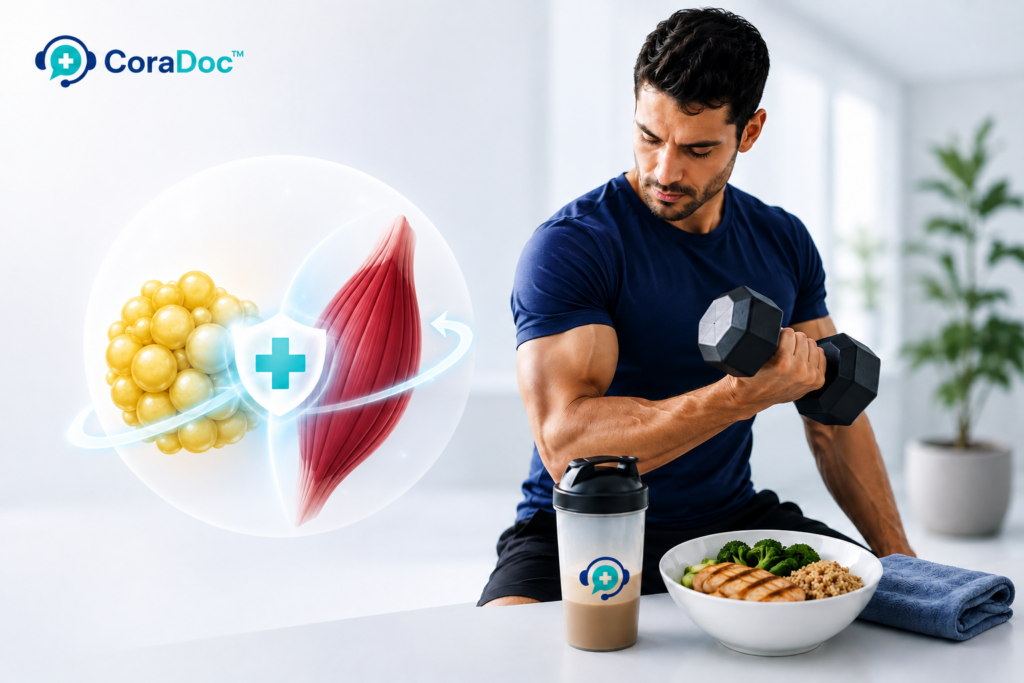
The Mistake That Burns Muscle Instead of Fat
“Am I losing muscle on this medication?”
It’s the first thing people Google after starting a GLP-1 program. And it’s a fair question — because it can happen. But the reason it happens is not the medication. It’s what you do — or don’t do — alongside it.
When the body is in a caloric deficit, it pulls energy from two sources: fat stores and muscle tissue. Without the right inputs — protein and resistance — the body treats both as fair game. That’s true on any program, any diet, any protocol. It’s not a GLP-1 problem. It’s a nutrition-and-movement problem that GLP-1 makes visible because the composition change happens faster.
THE TRUTH
The medication didn’t burn your muscle. The missing protocol did.
Get a program that protects lean tissue.
CoraDoc physicians build your plan around nutrition + medication together.
Why the body eats its own muscle — and how to stop it
Muscle is metabolically expensive. It takes energy to maintain. So when the body senses a sustained energy deficit, it does the “efficient” thing: it breaks down muscle for fuel because keeping it costs more than losing it. The technical term is muscle protein breakdown — and it’s a survival mechanism, not a flaw.
The good news: the body only does this when it doesn’t have a reason to keep the muscle. Give it a reason, and the equation flips.
- Protein signals “keep this tissue.” Amino acids — especially leucine — activate mTOR, the molecular switch that tells muscle cells to repair and rebuild rather than break down. Without enough protein, that switch stays off. The muscle gets no protection order.
- Resistance creates the demand. When you load a muscle against resistance, you create mechanical tension — the stimulus that tells the body this tissue is in active use and must be preserved. No tension, no demand signal. The body assumes you don’t need it.
- GLP-1 sets the environment. GLP-1 medications reduce appetite and slow gastric emptying — which means you eat less. That’s the point. But eating less of the wrong things is the mistake. When protein drops with calories, the body loses muscle alongside fat. When protein stays high, it preferentially burns fat.
THE FORMULA
GLP-1 + high protein + resistance training = fat loss with muscle preservation. Remove any one of the three, and the ratio shifts toward lean tissue loss. This isn’t opinion — it’s consistent across published clinical data.
Five ways people accidentally lose muscle
None of these are laziness. They’re what happens when the medication works but the supporting habits don’t get built around it.
- Eating 800 calories because “I’m just not hungry.” Appetite suppression is a feature — undereating is not. Below ~1,200 calories the body accelerates muscle breakdown regardless of what else you do.
- Filling up on salads and skipping protein. Volume eating feels virtuous but if protein drops below 0.7g per pound of body weight, you’re handing the body permission to catabolize lean tissue.
- Only doing cardio. Cardio burns calories. That’s it. It sends zero preservation signal to muscle. Without resistance, the deficit takes from both compartments equally.
- Skipping meals entirely. Muscle protein synthesis works on a per-meal cadence. You need 3–4 protein-rich meals spaced through the day to keep the rebuild signal active. One big dinner doesn’t cover it.
- Not telling your provider what you’re eating. Your physician can only adjust the plan if they know what the plan looks like in practice. Nutrition intake is clinical data — treat it that way.
Your provider should know what you eat.
CoraDoc programs include nutrition guidance — not just a prescription.
The muscle-protection protocol: six rules that keep the right tissue
This is the checklist physicians and sports-medicine researchers agree on. Every item is actionable today.
- Hit 30g protein per meal, minimum. That’s the leucine threshold to switch on muscle protein synthesis. Chicken breast, Greek yogurt, eggs, whey — hit the number before anything else on the plate.
- Lift 2–3 times per week. Full-body compound movements: squats, presses, rows, hinges. You don’t need to be an athlete — you need to load the muscle enough to tell the body it matters.
- Don’t drop below 1,200 calories. Even if appetite is low, eat enough to fuel the preservation signal. A protein shake counts. Prioritize density over volume when hunger is suppressed.
- Spread protein across 3–4 meals. Muscle protein synthesis has a refractory period — it resets roughly every 3–5 hours. One 90g dinner doesn’t trigger MPS three times. Three 30g meals do.
- Sleep 7+ hours. Growth hormone peaks during deep sleep. Muscle repair is overnight work. Cutting sleep cuts recovery — and recovery is where the preservation actually happens.
- Track body composition, not just the scale. Waist circumference, how clothes fit, progress photos, or a simple tape measure tell you what’s leaving and what’s staying. The scale can’t.
Get a plan built around body composition.
CoraDoc physicians guide medication + nutrition + movement together.
Burn fat. Keep muscle. Know the difference.
GLP-1 medications are one of the most effective tools available for metabolic health. But a tool without a protocol is just a tool. The people who get the best outcomes are the ones whose plan covers all three inputs: medication, nutrition, and movement.
That’s what CoraDoc builds. Not just a prescription shipped to your door — a physician-guided program that accounts for what you eat, how you train, and how your body is changing over time. Because composition matters more than a number.
What CoraDoc programs include
Licensed physician oversight throughout your program · dosage adjustments as your body changes · nutrition guidance to protect lean tissue · ongoing care-team support by real humans · compounded semaglutide from $99/mo or compounded tirzepatide from $149/mo · free visit, free shipping, free supplies.
✓ Doctor-prescribed ✓ All 50 states ✓ LegitScript certified ✓ No subscription
Protect your muscle. Start with a physician.
Free consultation · no commitment · most patients treated in 48 hours.
KEEP READING
Educational only — not medical advice. This guide is for general information and is not a substitute for consultation with a licensed healthcare provider. It does not diagnose, treat, or guarantee any outcome. Statistics cited are approximate and drawn from published clinical literature.
Prescription products are dispensed only if a licensed provider determines they’re appropriate for you. Certain medications offered through CoraDoc are compounded and are not reviewed or approved by the FDA for safety, efficacy, or manufacturing quality. Semaglutide and tirzepatide are not for everyone; potential side effects should be discussed with a provider. Individual results vary.